As a functional nutritionist, I never look at fertility as an isolated concern. Fertility is a reflection of whole-body wellness. And when we begin to understand this, everything changes.
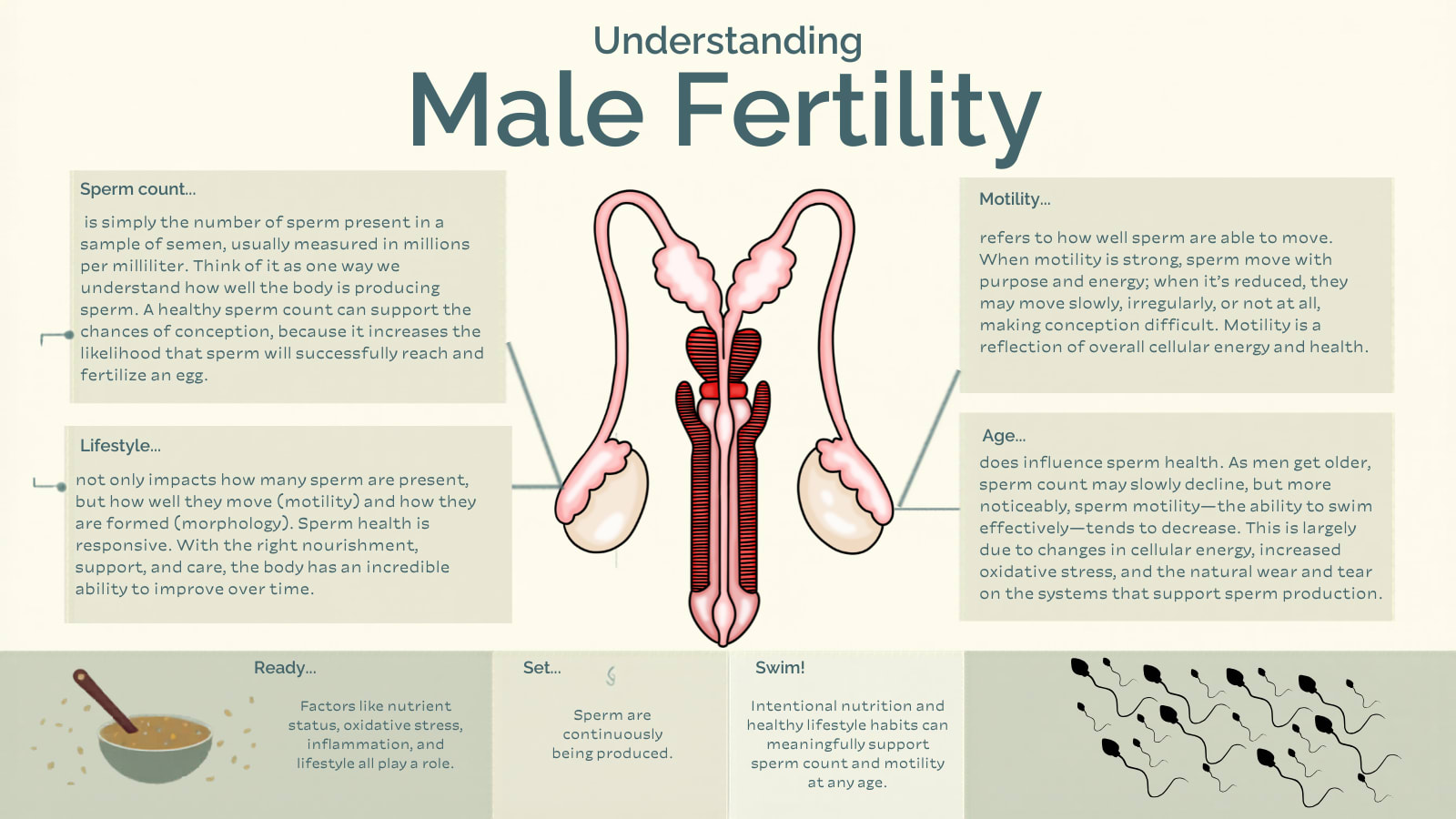
Sperm, in particular, are exquisitely sensitive to the internal environment. They respond to inflammation, oxidative stress, hormone balance, micronutrient sufficiency, and even emotional strain. In many ways, they are storytellers, quiet messengers revealing what is happening beneath the surface of a man’s health.
Over the past five decades, that story has shifted in a concerning direction. A 2022 meta-analysis published in Human Reproduction Update revealed that global sperm counts have declined by more than 50% since 1973, with the steepest drops occurring since the early 2000s. Today’s men, on average, are producing half the sperm of their grandfathers. And it is not just about quantity, motility, morphology, and testosterone levels are also declining.
This is not simply a fertility issue. It is a signal broader reflection of modern life. Environmental exposures, endocrine-disrupting chemicals, nutrient-poor diets, chronic stress, and yes, microplastics, are reshaping male reproductive health in ways we can no longer ignore. And yet, when couples begin their fertility journey, the focus so often starts, and stays, with her. Her cycle. Her labs. Her nutrients. All of that matters deeply. But conception is never a solo act. Male fertility is not a side note—it is half the story.
I have sat with countless couples who feel exhausted, discouraged, and unseen after years of trying. And time and again, something shifts when we bring him fully into the conversation when we nourish his body, support his physiology, and honor his role in this process. Energy returns. Markers improve. And hope begins to rise again.
The Sperm Are Talking: Are We Listening?
Sperm are more than reproductive cells. They are indicators of vitality. They reflect nutrient reserves, oxidative balance, toxin exposure, hormonal signaling, and stress physiology. If they could speak, they would say:
“Support the environment I live in, and I will do what I was designed to do.”
Daily choices matter. What a man eats, how he sleeps, how he manages stress—all of it shapes sperm quality. A nutrient-depleted diet, toxic burden, or chronic stress can result in reduced motility, impaired function, and even DNA fragmentation. But here is the empowering truth: sperm regenerate approximately every 72 days. That means every three months, there is an opportunity to rewrite the story.
Fertility Foods for Him: Building Resilience from Within
Nutrition is foundational but not in a superficial way. This is about targeted nourishment.
One of the central drivers of declining sperm health is oxidative stress, a process much like internal “rusting,” where unstable molecules damage cellular structures, including sperm. The good news? Food is a powerful form of protection.
-
Zinc supports testosterone production and sperm count
Pumpkin seeds, lentils, chickpeas -
Vitamin C & E act as potent antioxidants, protecting sperm from oxidative damage
Citrus fruits, red bell peppers, almonds, sunflower seeds -
Selenium enhances motility and structural integrity
Just 2 Brazil nuts per day can meet needs -
Omega-3 fatty acids (EPA & DHA) improve membrane fluidity and reduce inflammation
Sardines, mackerel, wild-caught salmon, or algae-based supplements -
Glutathione support strengthens the body’s master antioxidant system
Spinach, avocado, asparagus, broccoli, cabbage
While plant-based omega-3s like ALA (from flax, chia, and walnuts) absolutely have value, we must be honest about their limitations. The body can convert ALA into the long-chain omega-3 fatty acids EPA and DHA. This process is inherently inefficient, often yielding less than 8% under ideal conditions. And for many individuals, it is even lower.
What’s often overlooked is that this conversion happens along a shared, competitive pathway. Omega-3 and omega-6 fatty acids rely on the same enzymes to be metabolized. So, the more omega-6 fatty acids present in the diet, which is very common in today’s food environment, the more those enzymes are “occupied,” leaving less capacity for omega-3 conversion. In simple terms: higher omega-6 intake directly reduces the body’s ability to produce EPA and DHA from ALA.
Layer onto that the reality of genetic variation, where some individuals have reduced activity of the enzymes needed for conversion, along with factors like age, inflammation, and overall metabolic health—and we begin to see why relying on ALA alone is often not enough.
This is why I gently guide clients to think beyond just “getting omega-3s” and instead focus on getting the right forms of omega-3s. For optimal sperm health, and really, for whole-body resilience, direct sources of EPA and DHA, whether from low-mercury fatty fish or high-quality marine or algae-based supplements, are far more effective.
Because at the end of the day, the body has a limited capacity to make these critical fats on its own. And when we provide them directly, we support not just fertility, but cellular integrity, hormonal balance, and the deeper physiology that allows the body to truly thrive.
The Hidden Threat: Microplastics and Hormonal Disruption
There is another layer to this conversation, one that is largely invisible, yet profoundly impactful.
Microplastics. These microscopic particles are now found in our air, water, food, and even within the human body, including semen and testicular tissue. They are not passive. They carry endocrine-disrupting chemicals such as BPA and phthalates—compounds that mimic hormones, disrupt signaling pathways, and interfere with testosterone production and reproductive function.
Exposure happens daily:
-
Through plastic food packaging and bottled water
-
Through inhalation of indoor dust and synthetic fibers
-
Through seafood, salt, and even tea bags
-
Through personal care products and environmental residues
Over time, this accumulation contributes to inflammation, hormonal disruption, and oxidative stress within reproductive tissues. And perhaps most concerning, emerging research suggests these exposures may lead to epigenetic changes, alterations in gene expression that can affect not only fertility today, but the health of future generations.
Protection Is Possible
This is not a message of fear, it is a call to awareness and action. The body is remarkably resilient when given the right support. Small, consistent shifts create meaningful change over time.
-
Prioritize antioxidant-rich foods to buffer oxidative stress
-
Support detox pathways with fiber, hydration, and cruciferous vegetables
-
Choose glass or stainless steel over plastic when possible
-
Avoid heating food in plastic containers
-
Reduce reliance on highly processed, plastic-packaged foods
Rewriting the Fertility Story—Together
Up to 50% of infertility cases involve a male factor component. Yet far too often, men are left out of the care plan. That ends here. When men are informed, supported, and empowered, everything changes—not just fertility outcomes, but energy, mood, and overall vitality.
I have seen couples conceive after years of trying once we shifted focus to include him, fully and intentionally. And even when the journey is longer, something deeper is restored: a sense of agency, connection, and purpose.
Because fertility is not just about creating life. It is about restoring health. Rebuilding resilience.
And reconnecting with the body’s innate capacity to thrive. Every man deserves that opportunity. And every family deserves a care model that honors the full story.