There is a moment many parents describe with quiet confusion. The milk looked fine yesterday. The baby took it without hesitation. And then, suddenly, something changes. A smell. A taste. Baby refuses the milk. Mom’s response, “Something is wrong with my milk.”
Over the years, I’ve heard this story in many forms. And increasingly, I’m seeing a new explanation circulating: that “off milk” is the result of too much DHA, too many polyunsaturated fats, or an imbalance driven by supplementation. It’s an appealingly simple explanation. But human milk is not simple.
Human Milk Is a System—Not a Single Nutrient
One of the most important things we understand about human milk is that it functions as a living, integrated system. Nutrients do not operate in isolation, they protect, regenerate, and stabilize one another. This is especially true when it comes to oxidation.
At the center of this system is a network of antioxidants:
-
Vitamin C (ascorbic acid)
-
Vitamin E (alpha-tocopherol)
-
Vitamin A (retinol)
-
And even light-sensitive compounds like riboflavin
These nutrients are in constant interaction.
Vitamin C helps regenerate vitamin E.
Vitamin E protects lipid membranes from oxidation.
Vitamin A supports cellular integrity and immune function.
When this network is intact, human milk is remarkably resilient. But when that system is disrupted, we begin to see change.
What the Research Actually Shows
In controlled studies examining expressed human milk, something very consistent emerges:
-
Vitamin C declines during feeding and storage, particularly when milk is exposed to air through bottle systems
-
As vitamin C decreases, vitamin E and vitamin A also begin to decline, because their antioxidant protection is compromised
-
Light exposure accelerates this process, with riboflavin acting as a photosensitizer that triggers oxidative reactions
This is not theoretical. This is measurable, repeatable, and clinically relevant. And importantly, it happens within minutes to hours, not days.
The Missing Piece: Reactive Oxygen Species
To really understand what is happening, we have to talk about something less visible, but incredibly powerful: reactive oxygen species (ROS).
When human milk is exposed to light and oxygen, certain compounds—especially riboflavin—can generate reactive molecules like:
-
Superoxide
-
Singlet oxygen
These molecules are highly unstable. They seek out electrons, initiating reactions that damage nearby structures—particularly fats.
This is where the conversation about PUFAs comes in.
Polyunsaturated fats (including DHA) are naturally more vulnerable to oxidation. But vulnerability is not the same as harm.
In a protected system, antioxidants neutralize ROS before damage occurs.
But when:
-
Vitamin C is depleted.
-
Vitamin E is no longer regenerated.
-
Light exposure continues.
-
Air is repeatedly introduced.
…the system shifts.
And once that shift happens, ROS begin to drive a cascade:
Lipid peroxidation.
Nutrient degradation.
Changes in flavor and smell.
What families experience as “off milk” is often the sensory reflection of that cascade.
A Necessary Clarification: What About DHA Supplements?
This is where the conversation deserves more precision. Yes, it is absolutely possible for DHA supplements themselves to become oxidized (rancid). And when that happens, they may contain lipid peroxides and secondary oxidation products that can contribute to oxidative stress.
So, the concern is not unfounded. But we need to be very clear about what that means clinically. DHA itself is not the problem. It is:
-
A natural component of human milk.
-
Essential for infant brain and retinal development.
-
Responsive to maternal intake in a beneficial way.
The issue is quality and condition, not presence.
An oxidized supplement introduces a different variable: not “more DHA” but pre-oxidized lipids entering the system. And that matters. At the same time, even perfectly fresh DHA can become vulnerable if the antioxidant environment is compromised—which brings us right back to the core issue:
Oxidation is not driven by one nutrient.
It is driven by the balance between oxidants and antioxidants.
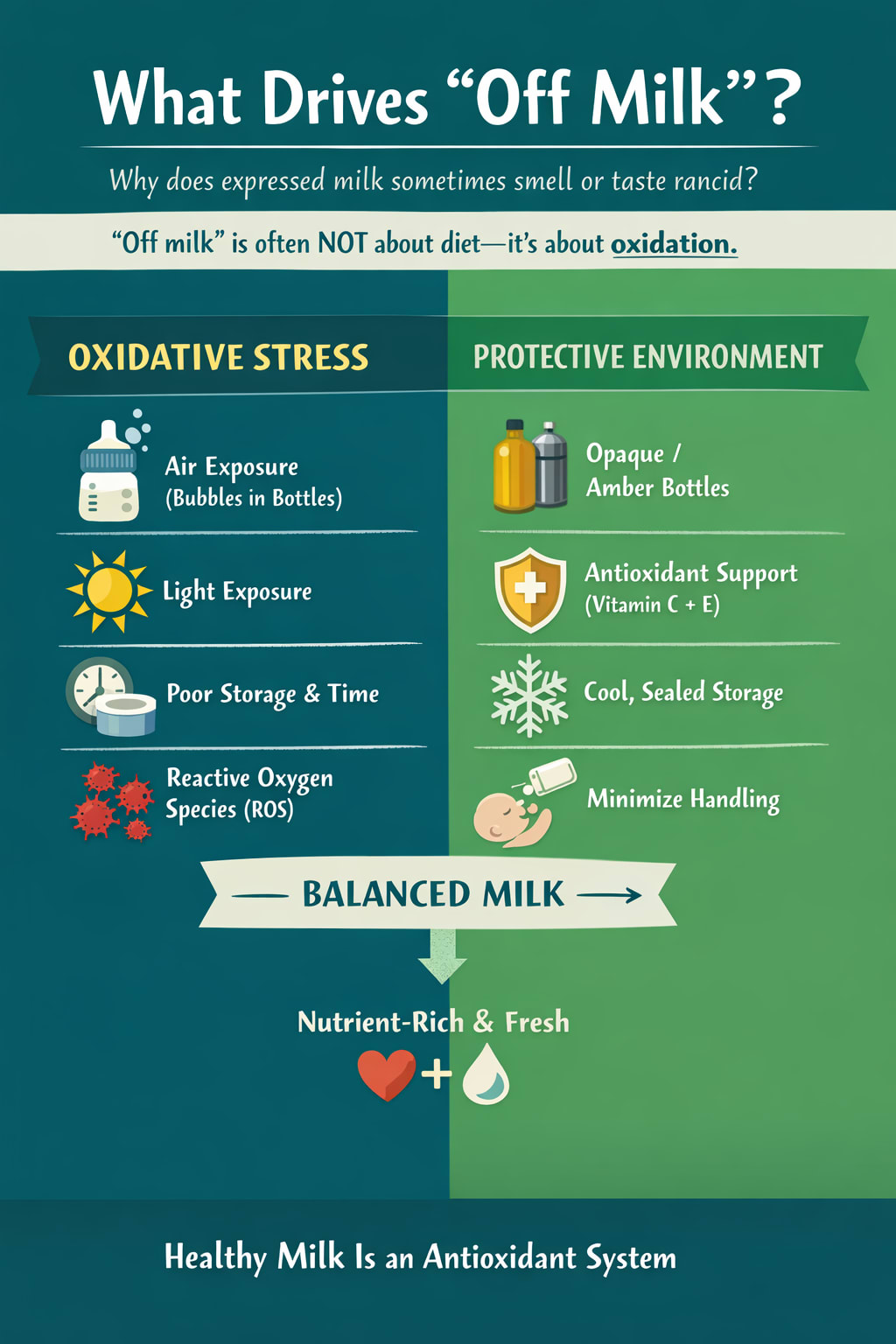
What Actually Drives “Off Milk”
When we step back and look clinically, the patterns become clearer.
“Off milk” is most often associated with:
-
Air exposure (especially bubbles introduced during bottle feeding)
-
Light exposure (clear containers, ambient light)
-
Storage conditions
-
Time and repeated handling
-
Declining antioxidant capacity over time
In other words, this is not primarily a diet problem.
It is a handling and environment problem.
A More Helpful Way to Think About It
Human milk was designed for one pathway: From breast → to baby.
When we express, store, transport, and reintroduce milk, we are asking it to function outside of that original design. And it does remarkably well. But not without limits.
So instead of focusing on:
-
Removing nutrients.
-
Avoiding DHA.
-
Or fearing specific components.
We can shift the conversation toward:
-
Protecting antioxidant integrity.
-
Minimizing light exposure.
-
Reducing air incorporation.
-
Supporting maternal nutrition overall.
-
Choosing high-quality, well-handled supplements when used.
The Takeaway
Human milk is responsive. It responds to light. It responds to oxygen. It responds to how we handle it. When it changes, it is not a failure of the mother or her milk. It is often a reflection of the environment we’ve placed it in. When we understand that, we move out of fear—and into stewardship. And that is where better care begins.